Friday, November 20, 2020

Forrest called

My Dad was an alcoholic and that figures in this story.  For years, he kept up daytime appearances, but gradually, it became more important to drink than to go out in public.  About age 65, he moved to a senior community where he didn't need to drive on a daily basis and that was fine with him.

Well, in the senior community, one Wednesday a month was sweeping day for the carports and every car had to be out for the afternoon. Dad had been drinking and got a reminder call to move his car.

He got into his car, backed out a car length, turned 90 degrees backwards, shifted into drive and blacked out.  The car rolled straight down the alley and hit a small tree at the end.  Dad banged his head on the steering wheel and the front bumper had a nice vee-dent in it.  The tree was knocked over and had to be replaced.  The paramedics took Dad to the hospital and I picked him up there late in the afternoon.

I remember taking him home, looking together at the car and the tree, and thinking to myself that tomorrow, the paper is going to say that "Bill Lever was drunk and hit a tree".  We are both William Lever, but our middle names are different, mine is "Dean", my mother's maiden name and his was "Forrest", his mother's maiden name.

Annoyed that people might think that I had hit the tree, I said to Dad, "Whenever you are a bad citizen, I want you to use you middle name so people won't think it's me."   He nodded in a haze and muttered an agreement. I thought that was that.

A couple of weeks later, I came back to my office from lunch and the receptionist gave me a message that "Forrest called".  Uh oh.

But then, it changed.  He remembered something about different names, so he began to mispronounce our last name.  We spell our family name "Lever" and the first "e" is long, pronounced "Lee-ver".  Perhaps 80 percent of the public will mispronounce the first "e" short, resulting in "Leh-ver"

Oddly, Dad, who was still doing consulting as civil and structural engineer, began to answer his telephone, saying in English style,  "Leh-ver here." 

This went on a while and I called his long-time attorney, telling him about his general state and the name change.  He recommended Dad might sign a power of attorney if it would become useful in the future.  We scheduled an appointment in his office.

On the appointment day, I arrived to pickup Dad with plenty of time, but he wasn't in any shape to go. I got him in the shower, dressed in suit and tie, and we arrived 45 minutes late. Only 15 minutes of our hour remained.

The attorney dangerously started by asking Dad "Bill how are you?" and there followed five minutes of his scattered, general troubles   Then, five minutes of amazingly clear recollection by both men of all the legal battles - this so and so, and that so and so, and that one too.

With only five minutes left of our hour, I interrupted out of the blue, "Mr. Attorney, what do you recommend?"

Without missing a beat, the attorney said "I recommend that Mr. Leh-ver over here sign a Power of Attorney for Mr. Lee-ver over there."   

"Great" said Dad and signed the Power of Attorney.


Thursday, November 19, 2020

The Moment I Became Old Aged

I remember clearly the instant that old age hit me.

I was 62, going to a weekday lunch with a friend. We agreed to meet at their office at a school district.

At the front counter, the young receptionist called my friend and said they would be up in a minute.

On the wall behind the receptionist, I noticed a sign that read “AED Here”.


As background, around the year 2000, I did some consulting to an Australian company that had an interesting CD-based (pre-internet) training program for cardiopulmonary resuscitation (CPR) and Automatic External Defibrillator (AED). It needed to be converted from Australian English to American English and some of the Australian humor just wouldn’t work in America.

It was great going through the details of the medicine, the agencies involved, producing the American script, and hiring, coaching, and recording American actors to read it.  

Because of the consulting, I have maintained a more-than-casual interest in CPR and AED’s.  So, when I saw the AED sign, I was curious if and how the receptionist had trained to use it.


So, I asked her if she had trained to use the AED.

She gazed up and must have thought I was as old as the hills. Her eyes grew wide and she had a shocked and worried look on her face.

Do you need it right away?” She said.

You are old aged the moment a casual question about a medical subject results in a 911 call.

Thursday, September 17, 2015

It was easier

Try to top this true story.  A guy came in our plastics shop in July to buy a piece of plastic 15 by 27.  So, we cut him a piece of plastic 15 inches by 27 inches.

He looked at the plastics and said "It's too big. It's supposed to be 15 inches by 27 centimeters."  I looked at him and I said, "How did you decide to measure in inches one direction and centimeters the other?"

He said he had a tape measure that reads inches on the top and centimeters on the bottom. When he measured the top, it was easier to read the inches and when measured the side it was easier to read the centimeters.

I was NOT expecting that.

A friend recommended that we charge the guy the same per square centimeter as we charge per square inch.  If he complained, just tell him it's easier that way.


Hemp Macaroons


Earlier this Summer, I stopped into Nature's Food Market and Juice Bar on H Street in downtown Bakersfield at lunchtime for a to-go sandwich and a juice drink. I recommend you try their store. 

Bakersfield Plastics had made some machinery parts for them and I wanted to see that they were working the way the store needed. 

Talking with the store owner, Chuck, is always a pleasure and he graciously gave me a box of macaroons they make.

Since they are from Nature's Food, there is going to be a natural food angle. So, the macaroons contain spirulina algae and hemp. They are dark green, but Chuck assured me that there is no active THC and he will not be putting a green cross on his building.


I put the cookies on the center console of my truck and drove off on the next errand which happened to be the federal prison at Taft

Only after driving past the prison entrance and reading a K-9 search sign did I realize that I did not want to have to explain bringing a box labeled "Hemp Macaroons" into a federal prison!

I found that the space under the truck seats decreases in proportion to the need to put something there in a hurry.

At the ATM

This morning, I went to a bank ATM to make a deposit a little after 7.

There on the keypad, was a paper receipt from 6:37 a.m. for a $20 cash withdrawal leaving a balance of $0.35.

A second customer found the receipt, read it carefully, formed an opinion of the first customer, got out a pen, looked to see that no one was watching, circled the balance, wrote "LOSER!", and left it for the rest of us to see.

So, who is the real loser here?

Human nature does not always please me, but it rarely surprises me.


Facebook responses to this story included:

Mark:Bill, please mail me my receipt. Thanks.

Rusty: I think $20.35 is way too much money to trust Wells Fargo with, good for him to get at least 20 back.

Sunday, July 13, 2014

My Belgian Pen Pal

Forty-five years ago, I was studying French in junior high school in Long Beach, California.  To increase interest, students could sign up for a French-speaking pen pal. I signed up and, voilà, my pen pal was Christine Dallons from  Charleroi, Belguim.

Of course, I was a schoolboy then and I wrote schoolboy letters that were probably not very interesting.  Of course, she was a schoolgirl too and, truthfully, I could hardly make out her graceful cursive script.  Sad to say, we gave up after two or three letters.

I now live 120 miles away in Bakersfield, California. I run a small plastics manufacturing company.

My pen pal’s name has been banging around in my head these forty-five years and, recently, out of curiosity, I looked for her on Google and Facebook.

I didn’t find her exactly, but I did find an interesting family history of a man with the same last name from the same town in Belgium.  Thinking this was perhaps some sort of relative, I read on.   François Dallons, a glassmaker, moved his family from Charleroi, Belgium to Indiana in the 1890.  In1906, the gas field that fired the glass plant gave out and the plant closed overnight. The Dallons family moved to Stockton, California where there was work making glass for repairing San Francisco after the earthquake there.

In 1920, the immigrant’s son, Victor Dallons, moved his family to Bakersfield. In 1923 they bought some land, and built a house on 8th Street, just a few houses down the street from where my company is today!

When I saw a picture of the house, which I immediately recognized, I couldn't help but laugh how small the world is.

Reading on, the likelihood of a relationship to my pen pal doubled.   There was a second branch of the Charleroi Dallons family that had moved from Belgium to England and then Los Angeles.  During World War II, the grandson of  François Dallons, Willis Dallons, who lived on 8th Street, was stationed in Los Angeles, met and courted the granddaughter of distant relative Jean François Dallons, Suzanne Dallons.   They married and one of their sons, now retired and living in Florida set up the website I found. 

I haven’t found Christine yet, but she’ll be interested to know that her probable-relatives have been doing well in America.
 
The Dallons family moved on from the house on 8th Street years ago.


What an odd coincidence of human migration.  
I'm enjoying the World Cup soccer this year.  I think that once every four years is about the right dose for me.

On the funny side, I was talking to an old friend of mine here in California about the World Cup.  He's a Jew, was born in pre-Israel Palestine, served as a tank commander in the Israeli army in the 1973 Yom Kippur War and moved to California in the mid 1970's.  That just sets him up as a tough, funny, old guy with a rugged accent and direct manner of speech.

My friend doesn't have any favorites among the countries.  He watches games to enjoy the talents of several players he follows.  Among the top world players he was following was Luis Suarez of Uruguay.

A day or so after the Uruguay defeated England, we were talking on the phone and he said that just as the game was starting on TV,  a premonition came to him how it would end.  He said, "I looked at the TV and said 'Suarez, today you will score two goals.'"  That's just how it happened.

In the the next game, Suarez created quite a controversy by biting one of the Italian players.  I called my friend and left a message asking if he had predicted the bite.

He called me back. "My predictions are about human behavior, not animal."

Tuesday, June 24, 2014

Why would I bother?

In my plastics workshop, from time to time we need our saw blades sharpened.

A sales rep from the sharpening company comes a few times a year, takes the blades away and brings them back sharpened in a week or so.

One visit, out of idle curiosity, I asked the saw blade man if any of his customers ever lost a finger.
"Oh, yes,” he answered rather matter of factly.  “Probably about a digit a week."   I was floored. I had never expected that rate... and uncompassionately calling them “digits”...
 
He went on to the story of an oldtimer customer of his.  The old guy had run a lumber yard full of probably very dangerous saws without  accident. Retired for many years, he was using his table saw at his home shop and did the classic stupid thing.  After a saw cut, he tried to remove a little cutoff sliver and it dragged his finger into the blade, cutting it off.

"Did you get it sewn back on?" asked the saw blade man.  The oldtimer replied "I'm 92 years old. Why would I bother?"


The point is, there are stages in life that you haven’t even considered.  I'm still at the stage where the finger would get sewn back on.   

Tuesday, April 16, 2013

The Front Fell Off

This has to be one of the funniest comedy routines I have ever seen. It’s so well done that I never grow tired of seeing it again.

As background, the team of John Clarke and Bryan Dawe have appeared on a weekly TV news program in Australia for better than 20 years.

They do a three-minute satirical interview of someone important discussing a current event. 

Bryan Dawe is the straight man interviewer.  No hamming it up. Just-the-facts type questions. No obvious softball questions. 

John Clarke plays the interviewee, not an impersonation, but perhaps including a signature quirk of the real person, perhaps a hat, or sunglasses, or other unique trait.

The typical interview seems to unfold in three parts:
  1. Introduction and overly-solicitous greeting… “It’s nice to have you here…”
  2. Funny interview
  3. Announcement that “Time is up” and we get to see what a jerk the interviewee really is.
This episode is a political satire interview of Australian Senator Bob Collins, the Minister for Shipping in 1991.

You can find the interview at YouTube  and audio  www.mrjohnclarke.com.

The following is my transcription:

Interviewer:  Senator Collins thanks for coming in.

Senator Collins:  It’s a great pleasure, thank you.

Int:  This ship that was involved in the incident off Western Australia this week...

Sen:  Yeah, the one the front fell off?

Int:  Yeah

Sen:  That’s not very typical, I’d like to make that point.

Int:  Well, how is it untypical?

Sen:  Well, there are a lot of these ships going around the world all the time, and very seldom does anything like this happen ... I just don’t want people thinking that tankers aren’t safe.

Int:  Was this tanker safe?

Sen:  Well I was thinking more about the other ones...

Int:  The ones that are safe,,,

Sen:  Yeah,,, the ones the front doesn’t fall off.  

Int:  Well, if this wasn’t safe, why did it have 80,000 tonnes of oil on it?
Sen:  Well, I'm not saying it wasn't safe, it's just perhaps not quite as safe as some of the other ones.

Int:  Why?

Sen:  Well, some of them are built so the front doesn't fall off at all.

Int:  Wasn't this built so the front wouldn't fall off?

Sen:  Well, obviously not.

Int: "How do you know?"

Sen:  Well, ‘cause the front fell off, and 20,000 tons of crude oil spilled into the sea, caught fire.  It's a bit of a give-away."  I would just like to make the point that that is not normal.

Int:  Well, what sort of standards are these oil tankers built to?

Sen:  Oh, very rigorous ... maritime engineering standards.

Int:  What sort of things?

Sen:  Well the front’s not supposed to fall off, for a start.

Int:  And what other things?

Sen:  Well, there are ... regulations governing the materials they can be made of

Int:  What materials?

Sen: Well, Cardboard’s out

Int:  And?

Sen: ...No cardboard derivatives...

Int:   Like paper?

Sen:. ... No paper, no string, no cellotape. ...

Int:  Rubber?

Sen:  No, rubber’s out .. Um, They've got to have a steering wheel. There's a minimum crew requirement."

Int:  What's the minimum crew?

Sen:  Oh,… one, I suppose.

Int:   So, the allegations that they are just designed to carry as much oil a possible and to hell with the consequences, I mean that’s ludicrous...

Sen:  Ludicrous, absolutely ludicrous.  These are very, very strong vessels

Int:  So what happened in this case?

Sen:  Well, the front fell off in this case by all means, but that’s very unusual.

Int:  But Senator Collins, why did the front bit fall off?

Sen:  Well, a wave hit it.

Int:  A wave hit it?

Sen:  A wave hit the ship.

Int:  Is that unusual?

Sen:  Oh, yeah...  At sea? ...Chance in a million.

Int:  So what do you do to protect the environment in cases like this?

Sen:  Well, the ship was towed outside the environment.

Int:  Into another environment....

Sen:  No, no, no. it’s been towed beyond the environment, it’s not in the environment

Int:  Yeah, but from one environment to another environment.

Sen:  No, it’s beyond the environment, it’s not in an environment. It has been towed beyond the environment.

Int:  Well,  what’s out there?

Sen:  Nothing’s out there...

Int:  Well there must be something out there

Sen:  There is nothing out there... all there is .... is sea ...and birds ....and fish

Int:   And?

Sen:  And 20,000 tons of crude oil

Int:   And what else?

Sen:  And a fire

Int:   And anything else?

Sen:  And the part of the ship that the front fell off, but there’s nothing else out there.

Int:   Senator Collins thanks for joining us.

Sen:  It’s a complete void

Int:   Yeah, We’re out of time

Sen:  The environment’s perfectly safe.  .... We’re out of time?..  Can you book me a cab?

Int:  But didn’t you come in a commonwealth car?

Sen: Yes, I did, but

Int:  What happened?

Sen: The front fell off

Thursday, April 04, 2013

Financial suggestions for California's governor

Several years ago, I drafted a letter to then California Governor Arnold Schwartzenegger. I had several suggestions what to do to help California's fiscal problems.

The real lack of creativity in Sacramento is thinking that California cannot print money without limit like the federal government thinks it can.

Well, just use lottery tickets as a new form of California gold:


Pay state vendors in lottery tickets.

Pay tax refunds in lottery tickets.
 
Pay state employees in lottery tickets.

Pay state retirees in lottery tickets


Print lottery tickets without any winners.


Disoriented

Here's a word to ponder: Disoriented.

Today, we use the word "disoriented" to mean lost, not knowing where one is, or maybe unable to tell right from left or up from down.
 
But if we think of the prefix, "dis" meaning "not" and the root "-orient" meaning "East",we can think that the earliest meaning of disorientation might have been "not knowing which way is east."

But, today, looking at a map, clearly North is the most important direction.  What happened?

The magnetic compass was discovered around 1000 A.D. and since the  needle points north, it became the new direction for "orientation" and the drawing of maps.

In early history, East must have been the primary direction.  The sun rose there and travelers might re-orient themselves in the morning and figure which way they needed to go


The moment I became middle aged

I remember clearly the instant that middle age hit me.

I was 38 and my daughter was 3. It was Halloween night a little past 9 o'clock and trick or treaters were getting few and far between.

I went to the local big-chain grocery store to get some milk for my daughter's breakfast.

Of course, milk is at the back of the store, so that customers will pick up higher-profit impulse items on the way back to the front.

I'm savvy enough to know all that, but that night, I did fall for several of them and I was laughing at myself as I put them on the counter. I told the young woman checker that I had come only for the milk for my daughter's breakfast, but now I had the impulse items too.

Then came the blow. Without malice or any thought how cruel her words were, she said, "That is so nice. I like when my parents have me over for breakfast" -- leaving no doubt that this young adult thought me old enough to be her father.

Instant middle age.

Sunday, September 02, 2012

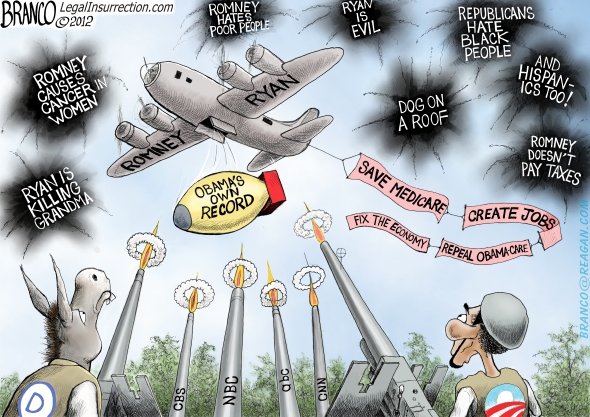
A.F. Branco - Political Cartoonist.

This is a great cartoon from A.F. Branco at the Legal Insurrection blog


I love the cartoon. I just keeps on giving.

This is the website: http://legalinsurrection.com/2012/08/branco-cartoon-flak-and-change/#comments

A bomber titled "Romney-Ryan is towing banners of hope. "Fix the economy, etc."

The flak gunners, Obama and the Democrat Donkey, are shooting their guns appropriately titled "CBS", "NBC", "ABC" and "CNN".

The flak explosions are all silly points "Romney hates poor people", etc. and the flak all misses the plane.

Finally, one sees that the bomb has been dropped and, best of all, it's title is "Obama's own record"

Sunday, August 12, 2012

Highspeed Derailment


Mitt Romney should make a campaign promise to cut all federal funds for California’s highspeed rail.
If you can promise to get rid of Obamacare, could you please get rid of Jerry’s train at the same time?
In Democrat-dominated California, if Mitt Romney is likely to lose the 55 electoral votes, he could make a point that would be popular outside of California, and strangely might be popular to a large number of the Golden state’s voters too.
Voters outside California would have a number of reasons to agree with cancelling this California pork, ultimately saving hundreds of billions.

Voters within California, a majority now having second thoughts about Jerry Brown’s train to nowhere, might hear fiscal sanity in a Romney promise to cut federal funding.  That might help Republicans in marginal races within the state.
What if it made California competitive by making its voters think about the economy?

You know, we did vote for Reagan. Several times.

Greetings from a 108-degree hot Sunday afternoon in Bakersfield, California. It's not that bad.

Wednesday, July 18, 2012

Why I am not a fan of TV news

Two 1987 TV news stories about the Golden Gate Bridge finished off my belief in TV news.  

I lived in the Los Angeles TV market, and in May 1987, the news ran fluff stories about the 50th anniversary of the opening of the bridge, started in 1933, finished in 1937. 

In September, when the stock market crashed, Los Angeles' KABC-TV ran a ridiculous, completely fabricated story. 

Former Miss America news anchor, Tawny Little, dutifully and sad, pouty-faced read the script something like this: 

"After the stock market crash today, an urgent call went out from the San Francisco Stock Exchange to the Golden Gate Bridge Authority to be on the look-out for despondent stockbrokers who might try to commit suicide by jumping off the bridge as they had in droves following the 1929 stock market crash."

Poor Tawny may have been easy on the eyes, but I don't think she troubled herself to remember the news from one broadcast to the next, much less from May to September.  

Analysis? out of the question. The obvious question:

Where did all those 1929 stockbrokers have to wait until the bridge was ready for them to jump in 1937...?


Sunday, October 30, 2011

"....Not good enough for me to understand.”

Nearly thirty years ago in Paris, I was walking alone on a sunny May afternoon and I decided to have a beer in a small local café near the Boulevard Saint-Germain on the Left Bank. Business was rather slow and there was a table available outside along the sidewalk. I was seated, the waiter offered the menu and I chose a beer from the Alsace region.

It’s important in this story to remember that the Alsace has flip-flopped a number of times between France and Germany depending on who won what war, but the Alsace has been French since the end of World War II.)

I enjoyed the beer, the sunshine, the people walking by, and my French-language newspaper. The major news stories were about another bombing in the Middle East, something that, sadly, hasn't changed much in all these years.

I’ve always liked studying and using languages. My high school and college French really isn't that bad - I’m a little proud to say that the best backhanded compliment I ever had about my French was from a French couple I sat next to on a flight somewhere. In conversation, they knew my accent was not from France, but they asked if I was from Quebec, at least thinking I was some sort of native francophone. They were surprised that I was from California.)

Now, back to the Paris café.

After a longish time, most of the other customers had left. The waiter brought the bill and returned inside. I looked at the bill and it was double the price of anything that I had seen on the menu.

The waiter didn't return, so I went inside and there by themselves were the barman and the waiter leaning on the bar.

In French I said to the waiter and the barman: "Excusez-moi... j'ai une question à propos de l'addition" ... ("I have a question about the bill") and explained that the bill seemed to be double the price from the menu.

They both scowled in Gallic, pained indifference and their body language was right out of an old Casablanca-style movie and looking for an argument. They both looked at me, leaned forward, elbows on the bar, then crossed and slapped their hands slowly on their upper arms in a comic pose as they listened to me.

Continuing in French, I pointed to the prices painted inside on the wall and continued to ask for a correction of the bill.

The waiter countered in French, "Well Monsieur, you have ordered a special foreign beer at a higher price." to which I pointed out that the Alsace had been returned again to France in 1945 and was not foreign at all.

Then the waiter pulled out his argument stopper. Still in French, he said, “Well then, Monsieur, I am sorry, but your French is not good enough for me to understand.” He wouldn’t hear anything more.

I was stunned. Nonplussed. It’s funny but you can’t actually tell someone that they understand you. Understanding is up to them.

So, stripped of the ability to argue, I fumed a bit and paid the double bill.

I went back out to my table, enjoyed a little more of the golden sunshine and read the whole French newspaper, not really caring if I was staying a little longer than might be expected of a customer.

When I finally decided to leave, I guess I felt that I had paid for the nice glass too, so I kept it.

Two blocks down the street, the waiter came running up and in English he said, “Hey, you can’t take that glass.”

I turned, looked at him, and replied sadly, “I’m sorry, but your English is not good enough for me to understand.”

He couldn’t say a word and I kept the glass.

Friday, October 07, 2011

Peer-to-Peer Car Sharing

I saw this idea to use GM's OnStar software and smartphones to form a “peer–to-peer” auto sharing network. The idea is: someone walking down the street uses their smartphone to locate and rent someone else's nearby car. Use the OnStar unlocking feature to open the car.

Yeah, it would work in a perfect world.

However, this world being imperfect, loaner cars would get less respect than shopping carts stolen from the supermarket. Private individuals won't put their cars in this program, but the government might.

For starters, since the government owns GM, it will subsidize GM. In lots of ways.

This peer-to-peer car idea might be the best way yet for big spending politicians to claim public good, spend lots of money to benefit themselves and their friends.... and walk away from the inevitable disaster.

Imagine the federal Peer-to-peer Car program: 

1) With a large fanfare, the federal government "creates jobs" by buying 10 million GM peer-to-peer cars. They are painted distinctive colors and have stylish “wraps” to advertise the politicians who promoted the project. 

2) The price to use one is cheaper than buying a car yourself. 

3) All peer-to-peer cars are snapped up instantly. The price is so low that no one actually pays. Cars are never returned. Cars are never washed. 80% of cars are never maintained. 20% of cars get $12,000 per year of government-paid goldbrick maintenance through a GM dealer boondoggle program. Lots of wrecks. Government insurance pays for it all. Millions of freeloader-voters love the free car program.

In two years, almost no peer-to-peer cars can be seen on the roads. They’ve been stolen, repainted, abandoned at airports and commuter train parking lots. Many people live in them.

In year three, if the Democrats are still in White House, the federal government offers $5,000 to scrap each car. The federal government pays for 14 million peer-to-peer cars to be scrapped. Yes, 40% more peer-to-peer cars than ever existed... did you really expect honesty or accountability?

Venture Socialism never works.

Tuesday, September 28, 2010

The next generation has a better idea. Again.

Five years ago, in my post "Ok, let's get a little creative", I was pleased when my son, then 11, faced a problem and came up with a solution I had not even come close to considering.

It has happened again.

Recently, from among the rest of our interesting customers, the county crime lab called my plastics company to solve a problem they were having with their handgun ballistics tank. The one where they shoot a handgun into water to recover sample bullets to compare with bullet fragments recovered at crime scenes.

My son has watched a number of the crime lab TV shows over the years. The crime lab people were very kind to give us a tour of the lab. The lab is very interesting. Basically the TV shows have the technology right, but the real world doesn't have the drama, the background music or the ability to solve several crimes in one hour.

When we got to the ballistics tank, we got to work. After a number of years, the stainless steel inside the tank had grayed, making it difficult to see the bullets at the bottom through four feet of water. A piece of white ABS plastic cut to size to provide good visual contrast. Problem solved. So far, so good.

Next, we looked at the porthole where light shines into the tank, allowing the lab technician to aim the handgun properly. Heat from the halogen lamp had caused a dark volcano-looking bump in the half-inch thick polycarbonate lens to rise from the surface towards the lamp. Replacing the lens would be easy, but how to prevent another volcano?

My solutions (incorrectly) focused on keeping the heat away from the plastic: 1) move the lamp farther away (not practical) 2) install a fan (possible, but some work) 3) install an automatic timer to turn off the lamp when the technician was away (possible, but some work).

The better solution was not long in arriving: "How about using an LED lamp instead of the halogen?" (eliminating the source of heat in the first place).

I believe this will be happening with greater regularity.

Thursday, October 23, 2008

"Equlibrium" House Prices

I was a 1989 Seal Beach buyer at the then highest prices ever. My wife was pregnant with our first child and I felt then that house prices might leave me behind for ever.

By 1992, I was wishing I had seen information on house price and inventory history like the information a number of excellent blogs present and link to these days.

Any market intervention - be it billions of federal dollars thrown at housing or a real estate owner saying that real estate "never goes down" - has only a temporary effect. The market goes where the buyers and sellers collectively decide.

We can all guess where that might be, and everyone is entitled to their own opinion.
For better or worse, throughout history, voicing an opinion contrary to the self interest of others has often invited unpleasant responses, blogs are no exception.

Now, my opinion for what little it is worth.

I believe that there is a fundamental numerical relationship between 1) personal income and 2) housing rent and 3)housing prices.

Stated differently: 1) A person can only pay a certain percentage of income for rent and 2) The rent a house commands times some multiplier determines its "equilibrium price"

By "Equilibrium price" I mean the price the market will tend towards as disturbances -- from Fannie Mae trillions to high or low interest rates to "my special neighborhood" etc., etc., etc. -- are abated. (Of course they will never be eliminated)

If we can agree there is a linkage between income and rent and house price, then we are merely discussing the normal ranges of the relationships.

Let's assume median two-income household income to be $70,000 in Southern California in 2008. Can someone provide some statistics there?

I'll suggest that the normal rent is 25% to 33% of personal income. Can we have some discussion on that?

Second, I'll suggest that the equilibrium price of a house is around 120 times monthly rent. Comments?

(Anecdotal data: I'm a CPA and the the best real estate deal I have ever seen a client make was 8 units in Phoenix purchased in 1996 for 80 times rent. It "penciled" and the buyer made money from day one.)

If you will allow me, here is a calculation using this income- rent-house price model:

Median household income is $70,000 per year, or $5,800 per month.

30% of income paid as rent is $1,750.

$1,750 rent times 120 gives a median house "equilibrium price" in the broad swath of median income - from Chatsworth to Pacoima to Downey to Riverside to San Bernardino to Garden Grove to Tustin - of $209,000.

This may sound low to many ears, but since 1985, housing prices have been held temporarily higher by government actions to cause easy lending: 1) raising the FDIC limit to reduce depositor interest in mortgage quality, leading to the 1980's lending frenzy, and 2) Fannie and Freddie buying trillions of low quality and inducing Wall Street to forget to check if mortgages could reasonably be repaid by the debtors.

With these two factors dead, we may now tend to a lower equilibrium price (in every neighborhood).

I would be greatful if those who disagree with me would suggest a better market model and name the next government program to boost housing prices so I can get in on the deal.

Ps. It may be that inflation is the next step for the government. That would make housing hurt less and put the hurt on savers (whose money is just in piles anyway...lol) and those on fixed incomes (think very small Social Security cost of living adjustments as prices and taxes soar.)

Thursday, June 21, 2007

Mexico View

My father was a structrual engineer and an alcoholic. Both of those facts figure in this story.

In 1958, at age 39, my dad was the project engineer for a large natural gas tank in Long Beach, California, a suburb 20 miles south of Los Angeles. The "Green Tank" at the 605 freeway and Carson Street was prominent enough to be the landmark for airplane pilots approaching Long Beach Airport from the east. On initial contact, air traffic controllers would direct pilots to "report inbound at the Green Tank."

Well, nothing lasts forever, and thirty years later, in 1988, the tank had reached the end of its service life and was scheduled to be demolished. Someone must have looked on the old plans, seen my Dad's name as the project engineer for building the tank, and he was hired at age 69 as the project engineer for the demolition of the tank, too.

So with the building and demolition of the project, we have "Part A" of our story, a patch of bare earth to which my father had some connection.

"Part C" must have come from some newspaper article or other my father must have read about the need for low-cost housing in the area.

And now, the years of alcohol, mostly Gordon's Gin and Jim Beam Whiskey, conjured in my father's brain "Part B," a hazy "pipe dream", [what a wonderful term -- originating from smoking an opium pipe] an idea which can only be imagined, and which would be impossible to carry out. Part B would fill the gap between Parts A and C.

My father would combine the vacant land and the need for low housing units by designing a tower on the available land, a tower tall enough to fit all the needed units... about 70 stories or so.... in a suburban area with no high rises at all... It was completely uneconomic and never would be considered for construction!

But, that didn't stop Dad.

In fact, the building would be so tall, that on a clear day, from the upper stories one would be able to see a very, very long way. Hence the name: "Mexico View".

And, so began the torture.

Dad began the structural calculations: "dead load" of the building, "live load" of the occupants and contents, wind loads, seismic calculations.... you name, it he had sketches and notes.

Foundation, structural steel, elevator shafts, plumbing, electrical, heating and air conditioning... every detail was considered... and related to anyone who would listen...

Letters about the project went to the city mayor, city council members, city planning commission, local congressional representatives... who knows who heard about this?

As an aside, in my family, for several generations, a son was given the name "William" followed by his mother's maiden name, then our family name. That is how my father was named and that is how I was named. The flood of letters about Mexico View must have been the point at which this family tradition died.

Mercifully, my son will not have to worry about his name being confused with William-me in a few years. (Maybe the Williams of yore keeled over before they got too batty - it would have been the most humane policy.)

Back to our story. Thanksgiving, Christmas, Easter, you name the occasion, blueprint drawings were presented for inspection. Endless monologue.. benefits.... low-cost housing... he called so-and-so they think highly of the project.. oh, God.

Then one day, I drove to Los Angeles airport to pick-up Dad's cousin from England, Barbara. She arrived, along with her son, Michael, his wife and their 5-year old son.

We were having a wonderful conversation driving south on the 405 freeway, Barbara in the front passenger seat, and family in the back. To American ears, Barbara sounds a bit like Angela Lansbury playing Mrs. Potts in Disney's Beauty and the Beast, or else all the ladies in Mary Poppins, except Julie Andrews .

Well, as we got to about Crenshaw Boulevard, the conversation went something like this:

Cousin Barbara: "Oh, Californian weather is so lovely....you know I've brought Michael to review the contract"

Me:" Oh? What contract is that?"

Cousin Barbara: "Well, the contract to manage Mexico View, of course!"

In an instant shock, I realized that my father had convinced his cousin to wind up her affairs in England and emmigrate to California to manage a 70-story building that didn't even exist!

I have no idea to this day how I managed to keep the car from driving off the edge of the road and what words I must have used to dimishish the size of that big building to make it fit only inside the head of my father.

The family had a nice vacation and all returned to England... Barbara has lived in Florida for a number of years now.

And.. I'm not sure that anyone ever heard of Mexico View from my father again...